LOCAL LAW 11 · COST GUIDE
What façade restoration costs in NYC
The short answer
There's no single price, because two walls the same size can be completely different jobs. On a FISP building, NYC contractors' 2026 price guides put minor façade repair at about $20 to $50 a square foot, moderate restoration at $50 to $150, and major restoration, where sections are rebuilt or terra cotta and stone replaced, at $150 a square foot and up. The city's own charges are small by comparison: $425 to file a FISP report. What moves the number is access, how much of the wall needs work, what's hidden behind it and what it's made of. What costs the most is waiting: an Unsafe condition left uncorrected draws $1,000 a month in penalties, plus a per-foot shed charge from the second year.
What NYC price guides publish
These ranges come from price guides NYC contractors and FISP consultants published in 2026, for the buildings FISP covers: seven stories and up. They're a guide, not a quote. Where your building falls depends on the access, scope and hidden damage described below.
| What | Published range by industry contractors |
|---|---|
| Façade repair, minor (pointing, patching, sealing) | $20 to $50 per sq ft |
| Façade restoration, moderate | $50 to $150 per sq ft |
| Façade restoration, major (rebuilt sections, terra cotta and stone replacement) | $150+ per sq ft |
| Brick repointing, low-rise with easy access | $15 to $25 per sq ft |
| Brick repointing, mid-rise from scaffold | $25 to $35 per sq ft |
| Brick repointing, high-rise, complex or landmarked | $35 to $50 per sq ft |
| Lintel replacement | $2,500 to $8,000 per lintel |
| Terra cotta repair or replacement | $500 to $5,000 per unit |
| Balcony structural repair | $7,500 to $40,000+ per balcony |
| Whole project, small residential building | $25,000 to $150,000 |
| Whole project, mid-size building | $100,000 to $500,000 |
| Whole project, large or high-rise building | $500,000 to $1,500,000+ |
| QEWI inspection, 7 to 12 stories | $8,000 to $18,000 |
| QEWI inspection, 13 to 25 stories | $18,000 to $40,000 |
| QEWI inspection, 26 stories and up | $40,000 and up |
Banu prices each building from its own FISP report and a walk of the wall, line by line, so the number reflects your wall and nobody else's. Request an Assessment
Where the money goes on your building
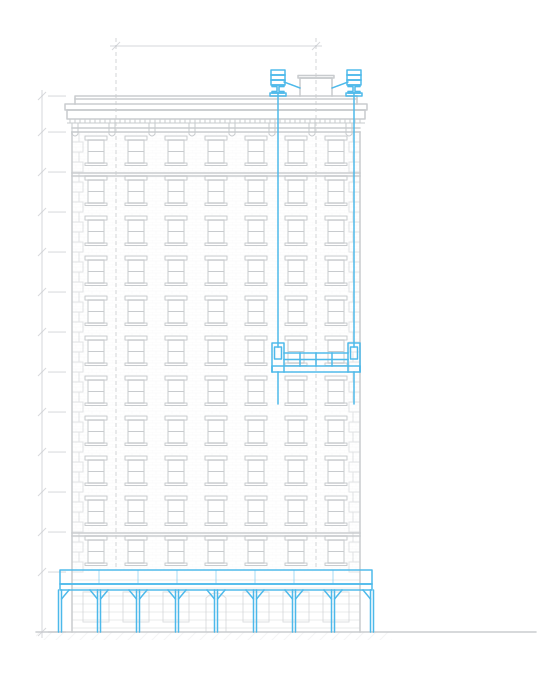
Square-foot prices hide more than they tell. These nine things are what move the number, and they're numbered on the drawing.
-
Access.
Suspended scaffold, the rigging behind it and moving the drops across each elevation. Rear yards, setbacks and roofs that can't take an outrigger all change the plan. We rig under our own Special Rigger license.
-
Public protection.
Sidewalk sheds and netting, on 90-day permits with a progress report at every renewal.
-
Height and the building next door.
Taller walls mean longer drops. A lower neighbor's roof can mean a license agreement before the rig goes up.
-
Scope and spread.
How many conditions the report lists and how spread out they are. Ten repairs on one elevation cost less to reach than ten scattered across four.
-
What's hidden.
Rusted steel behind brick and failed anchors behind stone only show up once the wall is open. Probes before pricing, and unit prices for the rest, keep the unknowns measurable.
-
Materials.
Brick is the easiest to source. Replacement terra cotta is usually made to order, and natural stone may need matching or new stone cut.
-
Landmarks.
LPC review adds time and narrows the material choices. LPC has designated 157 historic districts and extensions and protects more than 38,000 properties. In Manhattan, about 22% of lots with buildings of seven or more floors sit inside a historic district, by our count of the city's PLUTO data.
-
People, season and the street.
Phasing around residents and storefronts adds time. Winter work may need enclosures and heat, and the DOT holiday embargo shuts work on designated streets from November 15, 2026 to January 2, 2027.
-
Engineering and filings.
Your engineer's repair drawings and site visits, the DOB and DOT permits, and on some larger jobs a site safety manager. DOB's permit fee rises with the cost of the work. In a clear proposal, each of these is its own line.
What the city charges
DOB's own fees are fixed and small next to the work. Design, engineering and expediting fees come on top: your QEWI's inspection and report, your engineer's drawings and any permit filings.
| Fee | Amount |
|---|---|
| FISP initial report filing | $425 |
| FISP amended report filing | $425 |
| Extension of time to complete repairs | $305 |
| Request for waiver of penalties | $140 |
| Sidewalk shed permit | $160 for the first 25 feet, plus $10 for each additional 25 feet |
The clocks that turn into costs
Once a condition is filed Unsafe, the city's deadlines start doing the math. For a shed first permitted on or after January 12, 2026, Local Law 51 sets three milestones from the day of that first permit, each with a penalty of $5,000 to $20,000 if it's missed. Local Law 48 adds a charge for every month the shed stands with no work going on, starting at the second renewal.
| When (from the first shed permit) | What has to happen | Penalty or consequence |
|---|---|---|
| Every 90 days | Renew the shed permit, with a progress report | Renewal blocked while shed penalties are unpaid |
| Month 5 | Construction documents filed | $5,000 to $20,000 |
| Month 6 (second renewal) onward | Work in progress during each renewal term | Local Law 48 idle-shed penalty |
| Month 8 | Permit application filed and pursued | $5,000 to $20,000 |
| Month 24 | Repairs finished | $5,000 to $20,000 |
What an Unsafe condition costs if it isn't fixed
Under the FISP rule, an Unsafe condition that isn't corrected draws $1,000 a month from the start. From the second year, add a charge for every linear foot of shed, every month: $10 a foot in year two, rising to $40 by year five. On a 100-foot shed that comes to $180,000 over five years, before a single repair is made. A SWARMP item left from the last cycle and refiled as Unsafe adds a one-time $2,000 penalty.
| Year | Base penalty | Shed charge (100 ft) | Per month | Per year | Running total |
|---|---|---|---|---|---|
| Year 1 | $1,000 | None | $1,000 | $12,000 | $12,000 |
| Year 2 | $1,000 | $10 × 100 ft | $2,000 | $24,000 | $36,000 |
| Year 3 | $1,000 | $20 × 100 ft | $3,000 | $36,000 | $72,000 |
| Year 4 | $1,000 | $30 × 100 ft | $4,000 | $48,000 | $120,000 |
| Year 5 | $1,000 | $40 × 100 ft | $5,000 | $60,000 | $180,000 |
What an idle shed costs under Local Law 48
From the second permit renewal, every month with no work in progress can be charged per foot of shed: $10 while the shed is under three years old, $100 between three and four years, and $200 once it reaches four, with that last tier capped at $6,000 a month. On a 100-foot shed in its fourth year, that's $10,000 for each idle month. Keeping the work moving, and documented, keeps a shed out of these numbers.
| Shed age | Rate | 50-ft shed | 100-ft shed | 200-ft shed |
|---|---|---|---|---|
| Under 3 years | $10 per foot per month | $500/mo | $1,000/mo | $2,000/mo |
| 3 to 4 years | $100 per foot per month | $5,000/mo | $10,000/mo | $20,000/mo |
| 4 years or more | $200 per foot per month, max $6,000 | $6,000/mo | $6,000/mo | $6,000/mo |
What a shed costs, beyond the penalties
A shed is rarely the biggest line in a façade budget, but it's the one that keeps running. Rental is usually charged by the month, so every month the repair takes is a month of shed.
| Figure | Number | Source |
|---|---|---|
| Active sidewalk sheds in NYC (August 24, 2023) | 8,924 | Citizens Union, from DOB permits |
| Total length of those sheds | 380 miles | Citizens Union, from DOB permits |
| Average age | 482 days | Citizens Union, from DOB permits |
| Rental (December 2025) | $125 to $150 per linear foot for the first three months, then about 6% of that figure a month | Rand Engineering & Architecture, via CityRealty |
| Sales lost by a Manhattan business in a building with a shed | $3,900 to $9,500 less in card spending a month | NYC Mayor's Office with Mastercard, August 2024 |
On a 100-foot frontage, those rates come to about $12,500 to $15,000 to put the shed up, then roughly $750 to $900 a month. Ask for shed pricing as its own line in any proposal.
How prices have moved
In June 2021, JMA Consultants told Habitat magazine that façade inspection fees that used to run about $8,000 had climbed to $12,000 or more. Bids that came back in early 2021 ran 25% to 30% above proposals sent a few months earlier. And one building's façade bill went from $12,950 in the previous cycle to $275,000 in the next. Small SWARMP items left for later tend to come back as bigger repairs, with a shed attached.
Where Unsafe filings are most common
Unsafe filings are where the shed, the 90-day clock and the penalties above come in. In Cycle 9 about one in four initial reports citywide was filed Unsafe, and the share ran higher in Brooklyn and the Bronx. See the full NYC Façade Report →
| Borough | Filed Unsafe (Cycle 9) | FISP buildings |
|---|---|---|
| Manhattan | 24% | 9,151 |
| Brooklyn | 29.5% | 2,578 |
| Queens | 21.1% | 2,188 |
| The Bronx | 27.5% | 2,483 |
| Staten Island | Sample too small | 138 |
How to get a number you can rely on
- Start from the report. Your QEWI's report lists every condition. A proposal keyed to its numbering is the only kind you can check.
- Open up where the report points to hidden steel. Probes before pricing turn the biggest unknown into a measured one.
- Ask for unit prices for what nobody can see yet. Per brick, per linear foot of lintel, per anchor.
- Get access, protection and permits as their own lines. They're often among the largest items, and the easiest to compare.
- Compare like with like. Our guide to comparing façade repair bids walks through it.
Questions about façade costs
How much does façade restoration cost in NYC?
On a FISP building, NYC contractors' 2026 price guides put minor façade repair at about $20 to $50 a square foot, moderate restoration at $50 to $150, and major restoration, where sections are rebuilt or terra cotta and stone replaced, at $150 a square foot and up. For whole projects, they put a small residential building at roughly $25,000 to $150,000, a mid-size building at $100,000 to $500,000, and a large or tall building at $500,000 to $1.5 million or more. Access, scope and hidden damage decide where yours lands, and SWARMP items fixed early keep the number down.
How much does a Local Law 11 inspection cost?
Figures published in 2026 put a QEWI's FISP inspection at about $8,000 to $18,000 for a building of 7 to 12 stories, $18,000 to $40,000 for 13 to 25 stories, and $40,000 and up above that. The scaffold or drops for the close-up inspections are usually priced on their own. DOB charges $425 to file the report and $425 for each amended filing. Your QEWI quotes their own fee.
How much does a sidewalk shed cost in NYC?
The DOB permit is $160 for the first 25 feet plus $10 for each additional 25 feet, renewed every 90 days. Rental is the bigger number: in December 2025, Rand Engineering & Architecture put sheds at $125 to $150 per linear foot for the first three months, then about 6% of that figure each month after. On a 100-foot frontage, that's about $12,500 to $15,000 to put up and roughly $750 to $900 a month after that. Plan for Local Law 48 penalties if work stops.
What are the penalties for an Unsafe façade in NYC?
An Unsafe condition that isn't corrected draws $1,000 a month under the FISP rule. From the second year, there's also a monthly charge per linear foot of shed: $10 in year two, $20 in year three, $30 in year four and $40 in year five. For sheds first permitted on or after January 12, 2026, Local Law 51 adds a penalty of $5,000 to $20,000 for each missed milestone: construction documents at 5 months, the permit application at 8 months and finished repairs at 2 years.
Is it cheaper to fix all the SWARMP items at once?
Often, because you pay for access once per elevation and finish every repair on it while the rig is up. The trade-off is a bigger single outlay, so plenty of buildings phase the work elevation by elevation. Either way, a SWARMP item left past the next inspection comes back as Unsafe with a $2,000 penalty.
Why do two contractors' prices differ so much?
Usually because they priced different scopes, or made different assumptions about hidden damage and access. Ask both to price the report line by line, with unit prices for what nobody can see yet. The gap tends to shrink, or explain itself.
Does a landmark designation make façade work cost more?
It adds review time and narrows the material choices. Exterior work on an individual landmark or in a historic district needs a Landmarks Preservation Commission permit before it starts, and replacement terra cotta or stone usually has to match the original, which can mean made-to-order units and longer lead times.
Sources
- NYC Department of Buildings, Façade Fees & Penalties
- 1 RCNY 103-04, the FISP rule (penalty schedule for Unsafe and SWARMP conditions)
- Local Law 48 of 2025 (sidewalk shed penalties)
- Local Law 51 of 2025 (façade repair timelines)
- Citizens Union, Sidewalk Shed Reform in New York City (December 2023)
- CityRealty, sidewalk shed costs from Rand Engineering & Architecture (December 2025)
- Habitat magazine, Co-op and Condo Boards Getting Sticker Shock From Facade Repair Costs (June 2021)
- NYC Mayor's Office, sidewalk shed spending study with Mastercard (August 2024)
- NYC Landmarks Preservation Commission, About LPC
- NYC DOT, construction embargoes
- NYC Façade Report (Cycle 9 data by borough)
This page is general information, not legal or financial advice. Published ranges are industry figures, not Banu prices. Your QEWI and expediter confirm how the rules apply to your building.
Let's talk about your building
Want a number for your building?
Send us the report and a few photos of the wall. We'll walk it and price it line by line, so you know what each repair costs before it's built.