LOCAL LAW 11 / FISP · UNSAFE
Unsafe façade repairs, planned around your 90-day deadline
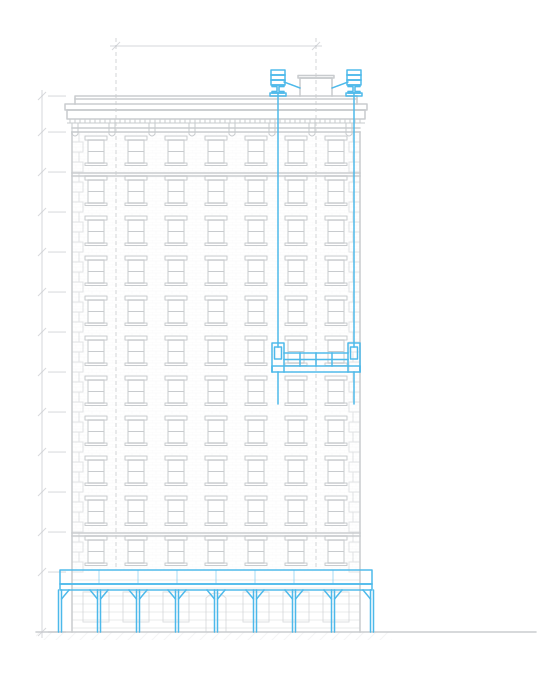
Protection goes up first. Then we build a repair plan that works back from your 90-day correction date.
An Unsafe FISP filing means your QEWI found a condition that's hazardous to people or property right now. You have to protect the public immediately and correct the condition within 90 days of filing, or apply for an extension. If the shed was first permitted on or after January 12, 2026, it also runs a clock of its own: plans in 5 months, a permit application in 8, repairs done in 2 years. Banu puts all of those dates into one plan.
Your first 90 days, step by step
| When | What happens | Who |
|---|---|---|
| Day 0 | QEWI notifies DOB and the owner, and recommends public protection. | QEWI |
| Immediately | Shed, fence or netting installed. Hazardous pieces made safe where possible. | Owner, with Banu |
| Week 1 | Site walk with the report. Repair scope and schedule. Permits and LPC (if landmarked) started. | Banu, your QEWI or architect |
| Weeks 2 to 10 | Repairs, with photo updates at key milestones. Extension request filed early if the scope needs more time. | Banu |
| Day 90 | Correction deadline. | |
| After repairs | QEWI re-inspects and files the amended report within two weeks, as the rule requires. | QEWI |
| After DOB accepts | Protection removed. Sidewalk restored. | Banu |
What we deliver
-
A plan built from your QEWI's report.
Scope, schedule, permits and protection, worked out at the start so the 90 days go to repairs.
-
Every deadline on one page.
Your 90-day correction date, any extension date and, for sheds permitted since January 12, 2026, the 5-month, 8-month and 2-year shed milestones.
-
Extension paperwork ready early.
If the work needs more than 90 days, you get the contract, schedule and progress records for the extension request while there's still time to file it.
-
A clean amended filing.
Photos of each corrected condition, keyed to the report, so your QEWI can re-inspect and file without chasing records.
-
Access on the 90-day clock.
We rig the make-safe and repair drops under our own Special Rigger license, so the clock isn't spent waiting on an outside rigger's calendar.
Services and capabilities
01 Protect
- Sidewalk sheds, fencing and netting where the rules allow (access and sheds)
- Make-safe work: loose material removed or secured
- Rigging for make-safe and repair work
- A site safety plan where the job requires one
02 Repair
- Displaced or bulging brick, rebuilt and re-anchored
- Cracked and spalled stone, terra cotta and concrete
- Failed lintels, shelf angles and relieving angles
- Unstable parapets and coping (parapets)
- Balcony slabs and railings (balconies)
- Cornices and decorative elements (landmark restoration)
03 Close out
- Photos and records for your QEWI's amended report
- Extension paperwork, if the scope calls for it
- Shed removal and sidewalk restoration
Questions about Unsafe conditions
Our QEWI filed Unsafe. What do we do first?
Get the public protected. Your QEWI recommends the type of protection (a sidewalk shed, fencing or netting) and where it goes, and it has to go up immediately. Then get a contractor on site with the report, so the repair plan, the permits and the schedule start moving while protection goes up.
How long do we have to fix an Unsafe condition?
90 days from the date the report is filed. If the work genuinely needs longer, you can apply to DOB for an extension of up to 90 days at a time. The application needs a $305 fee, a copy of the repair contract, your QEWI's time estimate and a notarized affidavit from the owner. Further extensions are possible only for specific reasons: an unforeseen delay such as weather or a strike, an unforeseen event such as a fire, or a hazard that needs more than 90 days to fix.
When can the shed come down?
Once the repairs are done and DOB accepts your QEWI's amended report. The rule requires your QEWI to file that report within two weeks after the repairs are completed. Your QEWI can also ask DOB to approve removing protection early, with a signed and sealed statement that the conditions it protects have been corrected. That helps most on buildings repaired one elevation at a time.
What are the new shed deadlines for Unsafe façades?
Under Local Law 51 of 2025, if the first permit for a shed protecting an Unsafe façade was issued on or after January 12, 2026, the clock starts at that permit. From there, complete construction documents must be filed within 5 months, a complete permit application filed and diligently pursued within 8 months, and repairs finished within 2 years. Each missed milestone carries a penalty of $5,000 to $20,000. If your repair contract runs longer than 2 years, you can apply for a single extension.
What penalties apply while the condition stays Unsafe?
DOB charges monthly penalties for failure to correct Unsafe conditions, on a schedule in 1 RCNY 103-04 that grows the longer the condition stays open. The shed itself now carries per-foot penalties as well when no work is happening, under Local Law 48 of 2025. DOB expects to start imposing those in early 2027.
Can you start before the permit is issued?
Protection, yes. Emergency work to make a condition safe, often yes, coordinated with DOB. Permanent repairs generally need the permit (and an LPC permit on landmarked buildings) before they begin. On the first site walk we'll sort out exactly what can start today and what has to wait.
Let's talk about your building
Your 90 days started when the report was filed
The clock is already running, and the sidewalk has to be protected before anything else. Send us the report and we'll walk the building with it, then plan the repairs back from your correction date.