FAÇADE SERVICES · MASONRY
Masonry restoration, brick repair and repointing in New York City
We repair brick and mortar to work with the wall around them, so the repair isn't the next thing to crack.
Masonry restoration is the repair of brick and stone walls. That means replacing damaged brick, repointing failing joints, rebuilding corners and closing cracks, and it's the most common work on FISP reports. Banu matches new mortar to the strength and color of your wall and fixes the water or steel problem behind the damage. Your QEWI gets photos of the repairs keyed to the report.
What we deliver
-
Mortar that suits the wall.
We mix it softer than the brick and match its color and texture. The joint takes the movement, and the brick stays whole.
-
The cause behind the crack.
We fix rusting lintels, failed ties and open flashing while the wall is open.
-
Brick and mortar matched on a test panel.
We settle the match before the full repair starts.
-
Swing stages that keep pace.
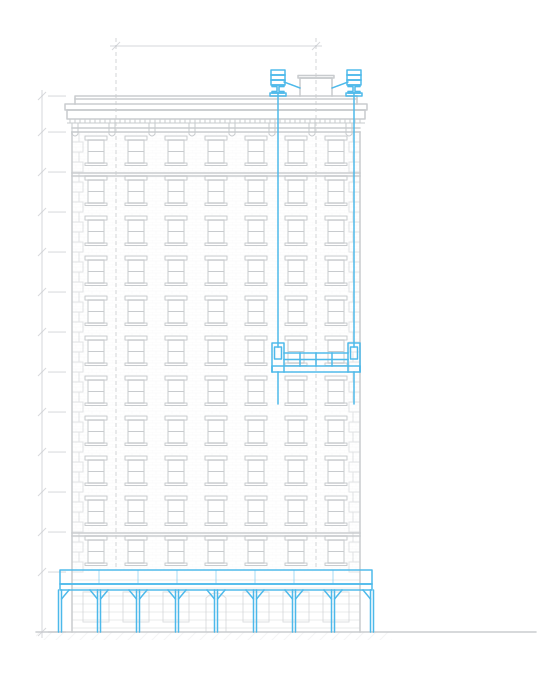
We rig them under our own Special Rigger license, so the drops move when the repointing does.
Services and capabilities
01 Investigate
- A condition survey, joint by joint where the wall calls for it
- Probes to check the ties, the backup wall and the steel
- Mortar analysis on older and landmarked buildings
02 Restore
- Brick replacement at any elevation
- Repointing of brick and decorative stone
- Masonry and stone corner reconstruction
- Crack repair and stitching
- Re-anchoring with helical ties where the face has pulled away from the backup
- Lintel and shelf angle repair while the wall is open (lintel and shelf angle repairs)
- Flashing and weep repair
03 Close out
- Test panels approved before the full repair
- Photo documentation keyed to your FISP report
- Windows and finishes protected, and the site cleaned up
Brick replacement at any elevation
We cut out cracked, spalled and loose brick and replace it with new or salvaged brick matched for size, color and texture. The new units are toothed in, stepped with the bond so they lock into the old wall. A straight seam between old and new would just give the next crack a place to start. We work from whatever access suits the wall: a pipe scaffold at the street, or a suspended scaffold at the top of a tower (access, scaffolding and sheds).
- Damaged units cut out without disturbing the brick around them
- Replacement brick matched on a test panel first
- New mortar matched to the strength and color of the wall
Masonry and stone corner reconstruction
Corners move more than the middle of a wall. Two faces expand and contract against each other, and any steel at the corner rusts and pushes the brick out. When a corner has cracked, bulged or separated, we take it down to sound masonry and re-set or replace the stone quoins. Then we rebuild it with the bond interlocking around the turn and new stainless ties into the backup. If movement caused the cracking, your engineer may add an expansion joint nearby so the new corner doesn't crack the same way.
- Temporary support wherever the corner carries masonry above
- Stone quoins re-set, or replaced to match
- Rebuilt brick tied back with stainless ties
Façade crack repair, in any material
A crack is a symptom, so we find the cause before we close it: rusting steel, a missing expansion joint, settlement or water freezing in the wall. Then the repair follows the material. In brick, we stitch helical stainless bars across the crack in the bed joints and repoint. Stone is pinned or patched (decorative stone repair). Concrete cracks are routed and sealed, or injected with epoxy where your engineer calls for it. Terra cotta has methods of its own (terra cotta restoration).
- The cause found before the crack is closed
- Brick cracks stitched with helical stainless bars
- Concrete cracks routed and sealed, or injected with epoxy
Signs your masonry needs work
- Mortar that's recessed, crumbling or gone
- Stair-step cracks climbing through the joints
- Brick faces that are cracked or spalled
- Sections of wall that bulge or bow
- Efflorescence (white salt deposits) on the face
- Gaps opening between the brick and the window frames
Questions about masonry restoration
What's the difference between repointing and tuckpointing?
On most New York buildings the two words mean the same job: grind out the failing mortar and pack in new. Strictly speaking, tuckpointing adds a thin decorative line in a contrasting color. What matters more is how deep the joint is cut (usually two and a half times the joint width) and which mortar goes back in.
How long does repointing last?
Done right, decades. Done wrong, a few winters. Most of the difference is the mortar you choose and how well the joints are prepared, and the water problem behind the wall has to be fixed too.
Why is our brick bulging?
Usually it's rusting steel behind the brick pushing it out, failed ties that once held the face brick to the backup wall, or water freezing inside the wall. Bulging brick can be an Unsafe condition, so get your QEWI to look at it now rather than at the next cycle.
Can you match our old brick?
Usually, yes. We source salvaged or new brick matched for size, color and texture, and build a test panel before the full repair. On a landmarked building, LPC approves the match.
Can masonry work be done in winter?
Some of it, with heated enclosures and cold-weather procedures. Mortar and patching materials have to stay above set minimum temperatures while they cure. LPC permits, for example, typically require patching and repointing to be done when it stays at 45°F or above for 72 hours from the start of work. We plan the most temperature-sensitive work for the warmer months.
Masonry across the boroughs
- Manhattan: Pre-war brick and stone, often trimmed in terra cotta.
- Brooklyn: Brick towers next to newer concrete and EIFS.
- Queens: Most of the borough's FISP façades are masonry.
- The Bronx: Art Deco brick, glass block and ornament.
- Staten Island: Brick parapets over storefronts and on North Shore apartment buildings.
Let's talk about your building
Send us photos of the wall
We'll look them over and tell you what the repair will take.