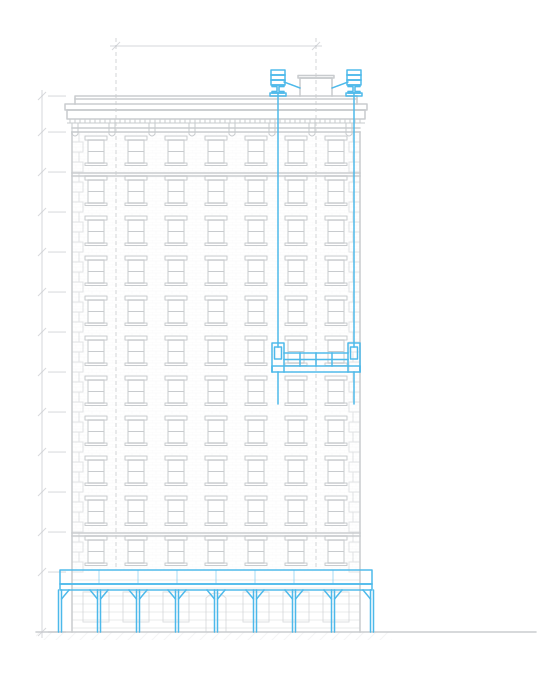
If you manage a New York building with a shed out front, you know the complaints by heart. Residents hate the dark walk to the door. Retail tenants say nobody can see their storefront. The board asks at every meeting why it's still up, and you'd like to know too.
Here is how a shed comes down, what changed in 2026, and the order of work that gets yours down soonest.
If your building was just filed Unsafe, start with our page on Unsafe façade repairs.
Why is your shed still up?
The shed is there because your QEWI found a condition that could hurt someone on the sidewalk. It stays until two things happen: the condition gets repaired, and DOB accepts the amended report your QEWI files after re-inspecting the work. (Once the conditions are corrected, your QEWI can also ask DOB to approve removal with a signed and sealed statement.)
So when a shed stays up for years, the shed itself is rarely the problem. The cause is almost always one of these:
- The repairs never started. Usually the board hasn't signed off on the work, or nobody has a scope everyone agrees on.
- The repairs started and stalled. A contractor walked off, the scope grew, or the board put the job on hold.
- The repairs are done but the paperwork isn't. The QEWI hasn't been back to re-inspect, or the amended report is still waiting to be filed or accepted.
- Something else is holding it. An LPC permit, a DOT permit, or an access agreement with the neighbor.
Until 2026, the penalties fell mostly on the uncorrected Unsafe condition. Now the shed draws penalties of its own.
What changed in 2026?
The mayor signed a package of shed laws in April 2025. The design standards took effect in August 2025, and the shed-permit and repair-deadline provisions followed on January 12, 2026.
| Law | What it does | What it means for you |
|---|---|---|
| Local Law 48 of 2025 | Shed permits last 90 days. Each renewal needs a progress report from a design professional. No renewal while shed penalties are unpaid. | Your shed's paperwork is now a quarterly job. |
| Local Law 48, penalties | From the second renewal, a shed with no active work can be charged per linear foot per month: $10 if it's under 3 years old, $100 at 3 to 4 years, $200 after 4 years (that tier capped at $6,000 a month). | A 100-foot shed with no work happening can draw $1,000 a month in penalties in its first years and $10,000 a month between years three and four. |
| Local Law 51 of 2025 | For FISP buildings whose shed protecting an Unsafe façade was first permitted on or after January 12, 2026: complete construction documents filed within 5 months, a complete permit application filed and diligently pursued within 8 months, and repairs finished within 2 years. Each missed milestone carries a penalty of $5,000 to $20,000. | Your repair schedule now has legal milestones. One extension is available if your repair contract runs longer than 2 years. |
| Local Law 47 of 2025 | New design standards (in effect since August 2025): taller clearance, approved colors, better lighting. It also directs DOB to allow containment netting instead of a shed in some locations, by rule. | New sheds look different. Once the netting rule is adopted, some buildings may not need a shed at all. |
DOB's rule implementing the penalties, 1 RCNY 102-07, took effect August 13, 2026. It also requires a work-progress log updated at least weekly. DOB has said it expects to begin imposing the per-foot penalties in early 2027.
Local Law 49 of 2025 is a separate matter. It lets DOB lengthen the FISP inspection cycle to between 6 and 12 years, and it took effect October 1, 2026, but DOB hasn't adopted a rule to use it yet. For your shed, it changes nothing today. (More in Local Law 49 and the next FISP cycle.)
What's the fastest legal way to get your shed down?
1. Find out exactly what the shed is protecting
Pull your QEWI's report and mark the conditions that required protection. Then look up your shed permit dates and your FISP status in DOB's records. You can't plan the end of a shed until you know which repairs it's waiting on.
2. Write down your clock dates
- The first shed permit date (if it was issued on or after January 12, 2026, the Local Law 51 clock starts here)
- 5 months from that date: construction documents filed
- 8 months: a complete permit application filed and diligently pursued
- 2 years: repairs finished
- Your next 90-day shed permit renewal
- If the report was filed Unsafe, your 90-day correction date and any extension
Put them on one page and hand it to the board. When a shed job slips, it's usually because nobody owned the calendar.
3. Get the drawings done
For most Unsafe conditions, your architect or engineer prepares construction documents and files for the repair permit. This is where shed jobs stall most often, because everyone assumes somebody else is chasing it. Chase it.
4. Scope the repairs so the shed can come down in pieces
Have your contractor sequence the work one elevation at a time, starting with the frontages that matter most to residents and retail. When a frontage is finished, your QEWI can ask DOB to approve removing protection there, with a signed and sealed statement that the conditions on it are corrected. That's the reason we plan shed jobs elevation by elevation wherever the building allows it.
5. Keep the work active, and prove it
The new penalties are aimed at sheds with no active work. Your evidence is the weekly progress log, the photo reports and the design professional's progress report at each renewal. A good contractor produces all of it without being asked. We keep the weekly log as a matter of routine and send photo reports at key milestones, so the paperwork is ready before a renewal comes due.
6. Close it out properly
When the repairs are done, your QEWI re-inspects and files the amended report. Get the contractor's photos, keyed to the report's numbering, into the QEWI's hands before that visit. A filing held up by missing documentation keeps a finished building under a shed for no reason.
7. Take it down and restore the sidewalk
Once DOB accepts the amended report, the shed can come down. Expect some sidewalk and curb repair as well, since sheds and delivery traffic are hard on both.
Can netting replace your shed?
Possibly, in time. Local Law 47 of 2025 directs DOB to allow containment netting instead of a shed where there's no public access below, and on certain adjoining exposures. DOB's rule is still a proposal (its public hearing was set for October 5, 2026), so netting isn't an option yet. Once it is, whether it suits your building will depend on the condition, where it sits and what your QEWI recommends.
What should you ask a contractor about your shed?
- When, specifically, will each section of the shed come down?
- Who holds the shed permit, and who handles the 90-day renewals?
- Will you keep the weekly progress log and send me photo reports?
- How will you sequence the work so sections can come down early?
- What happens to the schedule if you find more damage when you open the wall?
Vague answers usually mean the shed is staying a while.
Sources
- Local Law 47 of 2025: nyc.gov/assets/buildings/local_laws/ll47of2025.pdf
- Local Law 48 of 2025: nyc.gov/assets/buildings/local_laws/ll48of2025.pdf
- Local Law 51 of 2025: nyc.gov/assets/buildings/local_laws/ll51of2025.pdf
- Local Law 49 of 2025: nyc.gov/assets/buildings/local_laws/ll49of2025.pdf
- NYC DOB sidewalk shed service notice (2026): nyc.gov/assets/buildings/pdf/sidewalk_shed26-sn.pdf
- 1 RCNY 102-07: nyc.gov/assets/buildings/rules/1_RCNY_102-07_prom_details_date.pdf
- NYC Admin Code §28-302.5 (Unsafe conditions)
This article is general information, not legal advice. Your QEWI and expediter confirm how the rules apply to your building.