ACCESS SERVICES · SPECIAL RIGGING
Licensed Special Rigger: our own rigging for façade and FISP work
Your access, rigged under our own Special Rigger license by the same team that does the repairs.
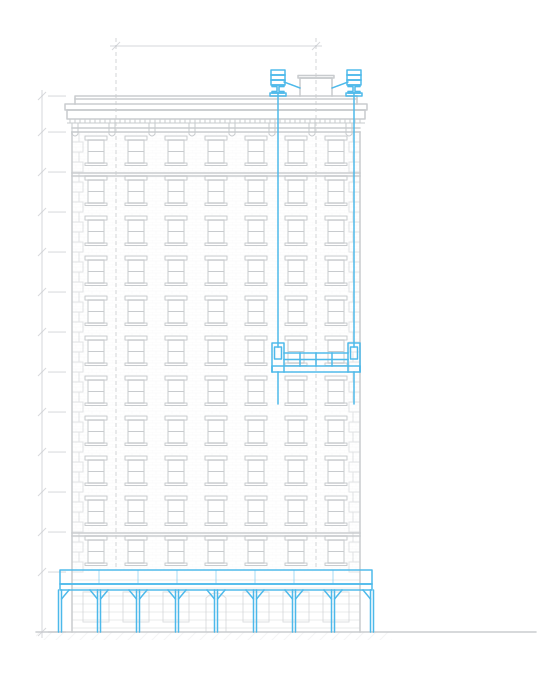
Banu Construction holds a New York City Department of Buildings Special Rigger license. Under the Administrative Code, that's the license that lets us install and use a suspended scaffold, the swing stage behind most façade, FISP and parapet work in the city. Because the license is ours, the drops hang where the repairs need them and come down when the work is finished.
The rules that apply
The license. A Special Rigger license authorizes the holder to install or use a suspended scaffold, and to hoist or lower articles of up to 2,000 pounds on the outside of a building with a hoisting machine rated for no more than 2,000 pounds.
Supervision. Whoever supervises the installation, use or removal of a suspended scaffold needs a DOB-approved course of at least 32 hours, then an 8-hour refresher every four years.
Training on the scaffold. Everyone who installs, uses or removes a suspended scaffold needs the DOB 16-hour course, with an 8-hour refresher every four years.
Sources: NYC Administrative Code §28-404.2; NYC Building Code §3314.4.5.
Why our own rigging matters
-
One company for the access and the work.
The team that plans the drops is the team that works from them, so each rig is set up around the repair it's there for.
-
Drops that follow the schedule.
Our own crews move the drops as the work advances.
-
A rigging plan you can follow.
Where each drop hangs, what holds it and how it's tied back, drawn up before the first outrigger goes on the roof.
-
Protection under the rig.
Pads under every outrigger and counterweight, and photos of the roof before and after.
Rigging services
01 Plan
- A roof survey of parapets, anchors, davits and tieback points
- A drop plan for every elevation, laid over the repair scope or your QEWI's inspection grid
- A rigging plan for each setup: outriggers, counterweights, tiebacks and parapet clamps
- Neighbor access and roof protection agreements
02 Rig
- Suspended scaffold installation, moves and removal under our Special Rigger license (suspended scaffold)
- Drops for QEWI close-up inspections (Local Law 11 repairs)
- Hoisting of materials up to 2,000 pounds on the outside of the building, within the license
- Rigging for façade, parapet, cornice and terra cotta repairs (façade restoration)
03 Keep it safe
- Ropes, rigging and equipment checked before work starts each day
- Work stopped and the rig secured in high wind
- Sidewalk sheds and netting below the drops where the public needs protecting (access and sheds)
- Rig removal, roof check and photos at close-out
Questions about special rigging
What does a Special Rigger license cover?
Under NYC Administrative Code §28-404.2, a Special Rigger license lets the holder install and use suspended scaffolds, and hoist or lower articles of up to 2,000 pounds on the outside of a building with a hoisting machine rated for no more than 2,000 pounds. That covers the swing stages used on most façade and parapet jobs.
Why does it matter that the rigging license is ours?
Because the rig moves when the work is ready to move. When a section of wall is finished, our crew shifts the drop to the next one under the same rigging plan, and you have one company to call about the access and the repairs.
Can you rig drops for our QEWI's inspection?
Yes. Your QEWI has to inspect hands-on at intervals of no more than 60 feet along every street-facing wall. We lay the drops over that grid, rig them under our license and move them as the inspection moves.
Who supervises the scaffold on site?
Anyone who supervises the installation, use or removal of a suspended scaffold needs a DOB-approved course of at least 32 hours, with an 8-hour refresher every four years. Everyone who works from the scaffold needs the 16-hour course and its refresher.
What about the roof and the building next door?
We survey the roof first: parapets, anchors, tieback points and what the membrane can take. Every outrigger and counterweight sits on protection. When a drop has to hang from or tie back to a neighbor's roof, we ask for a license agreement early. If a neighbor says no, RPAPL §881 lets an owner go to court for access, which takes time, so we raise it at the start.
Rigging across the boroughs
- Manhattan: Tight blocks of attached buildings, where a drop often has to tie back to the roof next door.
- Brooklyn: Waterfront towers and pre-war walk-ups, often on the same block.
- Queens: Big co-op complexes, where one rigging plan covers dozens of elevations.
- The Bronx: The Grand Concourse, where the ground falls away along a façade and each drop is a different length.
- Staten Island: Apartment buildings stepped up the North Shore hillside, where neighboring roofs rarely line up.
Let's talk about your building
Need access to the wall?
Tell us the address and which walls you need to reach. We'll lay out the drops and rig them under our own license.