LANDMARK SERVICES · 03
Restoring New York's landmark and historic façades
Repairs matched closely enough to disappear, with LPC approval in hand before anything comes off the wall.
Landmark restoration is exterior work on an individual landmark or on a building in one of New York's historic districts. Two things set it apart: the repair has to match the original, and the Landmarks Preservation Commission has to approve the work before it begins. Banu restores terra cotta, cornices, cast iron, water tables and decorative stone. We work with your architect on the LPC permit and produce the material matches and mockups the application depends on.
What we deliver
-
Repairs planned around the permit.
We choose methods and materials with LPC's review in mind, starting at the first probe.
-
Matches you can't pick out from the sidewalk.
Mortar, stone, terra cotta and paint matched to the original for color, texture and strength.
-
Original fabric kept wherever it can be.
Historic material is what the designation protects, so we repair first and replace only what's past saving. LPC prefers it that way too.
-
FISP and Landmarks on one schedule.
We plan your filing deadline and your LPC permit as a single sequence, so neither one holds up the other.
-
Drops rigged with the roof protected.
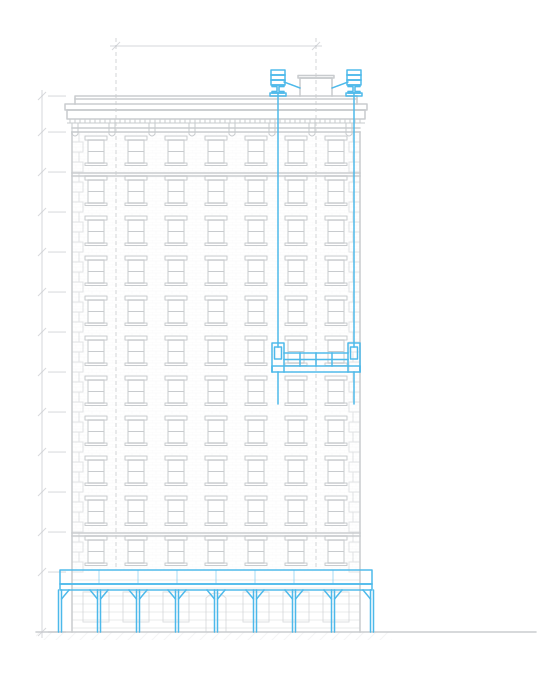
We hang the drops at cornices, terra cotta and stone under our own Special Rigger license, and protect the roof before any rig goes up.
Services and capabilities
01 Research and approvals
- Historic materials survey, with probes behind the face
- Mortar analysis, so the new mix matches the old
- Stone, brick and terra cotta sourced and matched to the original
- Samples and on-site mockups for LPC staff to review
- Repair methods for your architect's LPC application
02 Restore
- Decorative cornice repair and replacement (cornice restoration)
- Terra cotta repair, re-anchoring and replacement
- Decorative stone patching, dutchman repairs and re-anchoring
- GFRC units where LPC approves them
- Water tables repaired or replaced
- Cast iron repaired, with new castings for missing pieces (cast iron restoration)
- Historic windows restored, or replaced to match
- Sheet metal fabricated and repaired
- Repointing in historic mortar
- Gentle cleaning and re-coating suited to the material
03 Close out
- The documentation LPC needs to sign off the work
- Photo records your QEWI can file with the FISP report
- A maintenance plan written for historic materials
Which LPC permit your work needs
| Permit | Used for | Typical example |
|---|---|---|
| Certificate of No Effect | Work that needs a DOB permit but doesn't affect protected features | Many FISP repairs |
| Permit for Minor Work | Exterior work that doesn't need a DOB permit | Masonry repair, cleaning |
| Certificate of Appropriateness | Work that changes significant features. Needs a public hearing. | Re-cladding, new openings |
Source: LPC Permit Guidebook. Your architect confirms which applies.
Questions about landmark restoration
Do we need Landmarks approval for Local Law 11 repairs?
Yes, if your building is an individual landmark or sits in a historic district. Exterior work needs an LPC permit before it starts, with narrow exceptions for ordinary maintenance like repainting in the same color. FISP repairs that leave protected features as they are usually get a Certificate of No Effect. Masonry repairs that need no DOB permit usually get a Permit for Minor Work.
How long does LPC approval take?
Staff-level permits usually move much faster than anything that goes to a public hearing. Most delays come from incomplete applications and missing material matches. Your architect files. We get them the samples, mockups and repair methods early, so the application can go in complete the first time.
Can terra cotta be repaired, or does it have to be replaced?
Often it can be repaired. We pin cracks, patch small losses and re-anchor loose units. A unit too far gone is replaced in new terra cotta, or in GFRC or cast stone when LPC approves the substitute. More on terra cotta →
Why does mortar matter so much on old buildings?
Because the wrong mortar breaks old masonry. Modern portland-cement mortar is harder and less breathable than historic lime mortar. Put it in a 1910 wall and the brick or stone cracks before the joint does. We match the strength, color and texture of the mortar already in the wall.
Is my building landmarked?
Look it up on the LPC's Discover NYC Landmarks map, or ask your architect. About 38,000 New York properties are protected, most of them inside one of more than 150 historic districts and extensions.
Landmarks across the five boroughs
Manhattan has the most. About 1,665 tax lots with buildings of seven or more floors sit inside its historic districts, roughly one in five of the borough's tall buildings. Brooklyn, the Bronx and Queens have far fewer, clustered in districts like Brooklyn Heights, DUMBO, the Grand Concourse and Jackson Heights. Staten Island has three historic districts, mostly older houses and institutional buildings.
Source: NYC PLUTO, historic district field.
Let's talk about your building
Bring us in before the application
Samples and mockups take time, and LPC review moves faster when the application arrives complete.