LOCAL LAW 11 / FISP · PARAPETS
Local Law 126 parapet repairs, from the coping down
We repair or rebuild the parapet and fix what broke it, so next year's observation has less to find.
Under Local Law 126 of 2021 and DOB rule 1 RCNY 103-15, every New York building with a parapet facing a public right-of-way needs a parapet observation every year, at any height, starting in 2024. Detached one- and two-family homes are exempt, as are buildings with a barrier that keeps people away from the wall. Unsafe conditions must be reported to DOB, with the public protected immediately and the repair finished within 90 days. Banu repairs, re-anchors or rebuilds the parapet, then fixes the coping and roof connections that let the water in.
The parapet rule in plain English
| Question | Answer |
|---|---|
| Which buildings? | Any building with a parapet facing a public right-of-way, regardless of height. Exceptions: detached 1- and 2-family homes, and buildings with a fence or barrier that keeps people away from the exterior wall. |
| How often? | Every year, since January 1, 2024. |
| Who observes? | "A person competent to inspect parapets." No license required. |
| What's in the report? | Address, owner, observer's name and affiliation, date, location plan, construction details, conditions found, repairs since last report, dated photos. |
| Filed with DOB? | No. Kept for at least 6 years and shown to DOB on request. |
| If it's unsafe? | Notify DOB, install public protection immediately, repair within 90 days. |
Source: 1 RCNY 103-15 and DOB's parapet page.
What we deliver
-
Repairs scoped to the cause.
We fix what the observation found and whatever started it, which is usually water getting in at the coping or the railing anchors.
-
The roof edge in the same scope.
Coping, flashing and the roof membrane at the parapet are handled together, so the leak and the crack get fixed at the same time.
-
Dated photos for your parapet file.
Before-and-after shots you can attach to next year's observation report.
-
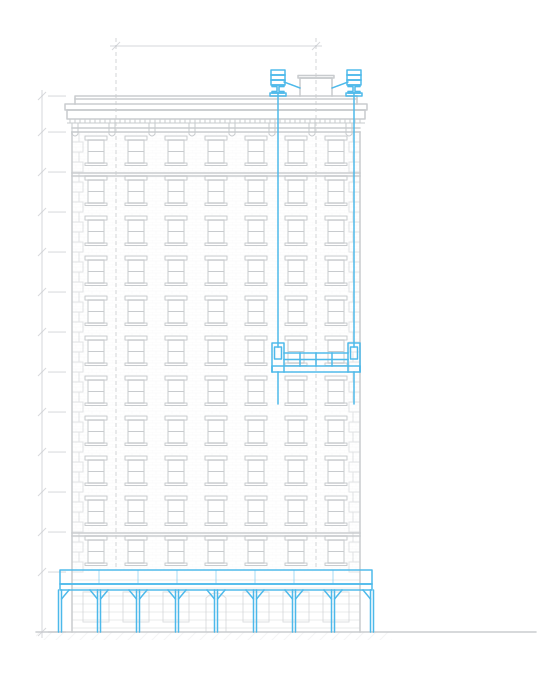
Swing stages for the parapet.
We hang them under our own Special Rigger license, from outriggers when the parapet can't carry a clamp.
Services and capabilities
01 Investigate
- Your observation reports and FISP report, reviewed together
- Hands-on inspection of the coping, joints, anchors and inside face
- Photos of what we find, with repair and rebuild laid out side by side
02 Restore
- Coping reset, re-anchored or replaced (stone, terra cotta, metal)
- Repointing and brick replacement
- Partial and full parapet rebuilds
- Through-wall flashing and counter-flashing
- Railing anchor repair and code-compliant railing installation
- Roof membrane tied in at the parapet (roofing)
03 Close out
- Dated before-and-after photos for your parapet file
- A heads-up to your QEWI when the parapet is part of a FISP scope
- A checklist for next year's observation
What observation reports usually flag
- Coping stones that are loose, rocking or cracked
- Open joints between coping units
- Cracks through the parapet, often at the corners
- A parapet leaning in or out
- Loose or missing brick
- Rusted railing posts or anchors
- Plants growing out of the joints
- Water stains on the top-floor ceiling below the parapet
Questions about parapets
Does our building need a parapet observation even though it's too short for FISP?
Probably, yes. The parapet rule covers any building with a parapet facing a street, sidewalk or other public right-of-way, whatever its height. The exceptions are detached one- and two-family homes, and buildings with a fence or barrier that keeps people away from the exterior wall.
Who's allowed to do the annual observation?
The rule calls for a person competent to inspect parapets. That can be a mason, a superintendent, an architect or engineer, or anyone able to identify the hazards, and no license is required. What matters is that the report covers everything the rule asks for: a location plan, construction details, the conditions found, repairs since the last report and dated photos.
Do we file the parapet report with DOB?
No. You keep it on file for at least six years and produce it if DOB asks for it. An unsafe finding changes that: you notify DOB right away, protect the public and repair the condition within 90 days.
Is it better to repair a parapet or rebuild it?
If the parapet is leaning, cracked through, or the brick is loose in more than a few places, rebuilding usually makes more sense over ten years than patching it every year. We'll show you photos of what we find and walk you through both options.
Why do parapets fail so often?
A parapet is exposed on three sides, so it takes more weather than any other part of the wall. Water gets in through the coping joints, freezes and pushes the brick apart. Add a roof membrane pulling at the inside face and railing anchors rusting in the wall, and you get the cracks, leans and loose coping that turn up in observation reports.
Parapets across the city
The parapet rule reaches far more buildings than FISP does. The five boroughs have about 13,000 tax lots with six-story buildings, every one of them just under the FISP threshold. Any of those with a parapet facing the street still needs its annual observation.
Source: NYC PLUTO, lots with exactly six floors. See borough data →
Let's talk about your building
Get ahead of next year's observation
Send us this year's observation report or a few photos of the roof edge, and we'll mark what should be fixed before the next one.