LOCAL LAW 11 / FISP · SWARMP
SWARMP repairs: clear the list before your next inspection
We work through your SWARMP list on your QEWI's timeline, so nothing carries into the next cycle as Unsafe.
SWARMP (Safe With a Repair and Maintenance Program) is the FISP classification for a façade that's safe today but has conditions that must be repaired within the cycle. If a condition is still open at the next inspection, your QEWI has to report it as Unsafe, and DOB charges a $2,000 penalty. Banu takes SWARMP items in order of urgency and schedules the last of them to finish before that inspection.
What we deliver
-
Every SWARMP item on its own line.
Numbered to match your QEWI's report, so you can follow each condition until it's closed.
-
A phasing plan built on your QEWI's timeframes.
The most urgent conditions go first. The last one is scheduled to finish before your next inspection.
-
Records your QEWI can file from.
Before-and-after photos of each condition, marked on the elevation.
-
Access for each SWARMP item.
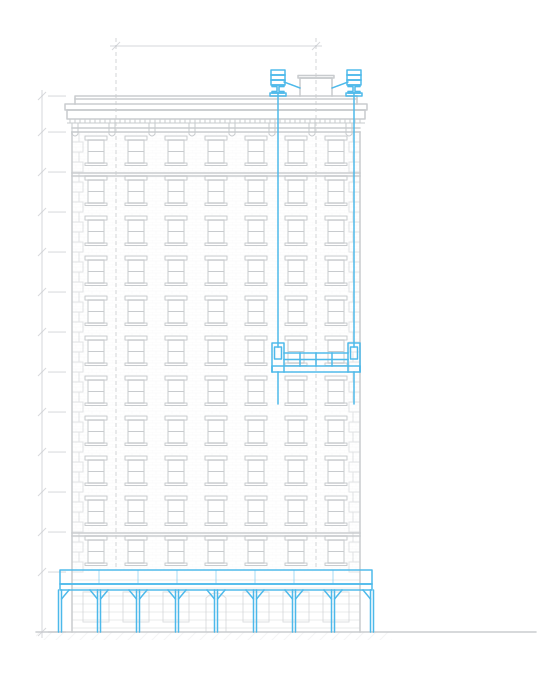
We rig the drops for your SWARMP conditions under our own Special Rigger license and set them where your QEWI's report puts the work.
Why SWARMP is worth fixing early
A SWARMP rating reads like a pass, and for now it is one. Look at what sits on most SWARMP lists, though: open mortar joints, minor cracks, early lintel rust, loose coping, deteriorated sealant. Each of those lets water into the wall. A few New York winters later, the SWARMP crack is a displaced brick, and a displaced brick is an Unsafe filing.
What changes when a condition moves from SWARMP to Unsafe:
| SWARMP | Unsafe | |
|---|---|---|
| Public protection | Not required just for the classification | Required immediately: shed, fence or netting |
| Deadline | Within the cycle, on your QEWI's timeframe | 90 days from filing, extensions on request |
| Penalty | None while you're within the timeframe | $2,000 for an unrepaired prior-cycle SWARMP, plus monthly Unsafe penalties if not corrected |
| Shed clock | None | Plans in 5 months, a permit application in 8, repairs finished in 2 years from the first shed permit |
| Scope | Usually smaller | Usually bigger, because the condition kept deteriorating |
Services and capabilities
01 Investigate
- Your current and prior-cycle FISP reports, read side by side
- A walk of every SWARMP condition with the report in hand
- Probes where the report points to hidden steel or anchorage problems
02 Restore
- Repointing and brick replacement (masonry restoration)
- Crack repair in brick, stone, concrete and terra cotta
- Lintel and shelf angle treatment or replacement
- New sealant and flashing
- Coping and parapet repairs (parapets)
- Balcony slab and railing repairs (balconies)
03 Close out
- Photos keyed to the condition numbers in your report
- A final walk-through with your QEWI
- A short maintenance list of what to watch before the next cycle
What a typical SWARMP list includes
- Open or eroded mortar joints
- Hairline to moderate cracks in brick, stone or concrete
- Surface rust on lintels, shelf angles or railings
- Failed or missing sealant at windows and expansion joints
- Minor spalling on concrete balconies and slab edges
- Loose or poorly anchored coping
- Peeling paint and worn coatings on steel
Questions about SWARMP
What does SWARMP stand for?
Safe With a Repair and Maintenance Program. Your QEWI found the façade safe at the time of inspection, but with conditions that need repair or maintenance within the five-year cycle (on a timeframe of at least one year) to keep them from becoming unsafe.
How long do we have to fix SWARMP conditions?
Your QEWI gives each condition a recommended repair timeframe, somewhere between one and five years. The firm deadline is your next inspection. Anything still unrepaired by then must be reported as Unsafe.
What's the penalty for leaving SWARMP conditions unrepaired?
DOB charges a $2,000 penalty for failing to correct SWARMP conditions from the prior cycle. The bigger consequence is the filing itself: the condition goes in as Unsafe, which brings immediate public protection, a 90-day repair deadline and, if a shed goes up, the 2026 shed milestones.
We have SWARMP items from Cycle 9 and our 10A window closes February 21, 2027. Is it too late?
No, as long as the work gets moving. Repairs finished before your QEWI's final inspection for Cycle 10 can be reported as repaired. Send us the Cycle 9 report and we'll work out what can be completed before your QEWI's inspection date.
Do SWARMP repairs need a sidewalk shed?
Not always. It depends on the work, the height of the building and what's below it. Many SWARMP repairs can be done from a suspended scaffold, with overhead protection or netting where the rules allow. We'll look at your building and explain what it needs and why.
Can we phase SWARMP repairs over several years?
Yes, within the timeframes your QEWI set. We phase the work by elevation or by urgency and lay it out as a multi-year schedule. The one fixed point is the end date: the last phase has to be finished before your next inspection.
Let's talk about your building
Have a SWARMP list?
Send it over. We'll go through it item by item and tell you what has to be finished before your next inspection.