ROOFING SERVICES · FAÇADE WATERPROOFING
Façade waterproofing and sealant replacement
We test the wall until we know where the water gets in, then repair what let it through.
Façade waterproofing keeps water out of the wall itself. The work covers sealant joints at windows and panels, through-wall flashing and weeps at lintels and shelf angles, and breathable water repellents on masonry. Most wall leaks trace back to one of those. Banu Construction water-tests the wall to find the source and replaces whatever failed. At the top, we tie the wall into the roof at the parapet.
What we deliver
-
The source found first.
Field water tests and probes, one suspect at a time, so the repair goes where the water gets in.
-
Joints rebuilt from scratch.
We cut out the old sealant, clean and prime both faces and set backer rod to the right depth before the new bead goes in.
-
Walls that can still dry out.
We pick repellents and coatings that leave moisture inside the masonry a way out.
-
One scope at the roof edge.
Parapet flashing and roofing are detailed together, so water can't find a gap where one ends and the other starts.
-
Drops that follow the sealant work.
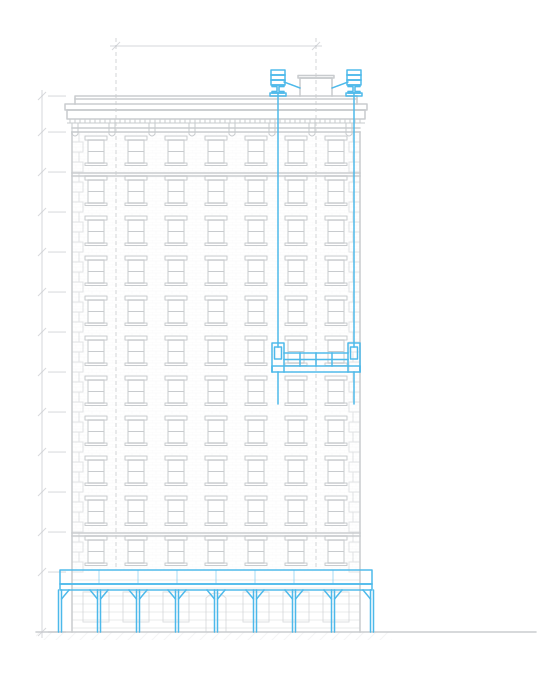
We rig them under our own Special Rigger license and move them elevation by elevation.
Services and capabilities
01 Investigate
- Leak maps built from residents' reports and interior stains
- Field water testing, one joint, window or stretch of wall at a time
- Probes at lintels, sills and shelf angles to see what the flashing is doing
02 Waterproof
- Sealant replacement at windows, doors and louvers
- Expansion and control joints in brick, stone and concrete
- Panel joints on precast, metal panel and curtain wall façades
- Through-wall flashing with end dams and weeps (lintel and shelf angle repairs)
- Breathable water repellents for brick, stone and concrete
- Coatings, on walls that can take them
- Coping joints and counter-flashing at the parapet, tied into the roof (parapets)
03 Close out
- Adhesion checks on new sealant before the scaffold moves on
- A second water test at the spot where the first one found the leak
- A joint map and photos for your maintenance file
Signs water is getting through the wall
- Stains or bubbling paint under windows after wind-driven rain
- Sealant that has cracked, gone rock-hard or pulled away from the joint
- Rust streaks below lintels and window heads
- White salt deposits (efflorescence) on the brick
- Brick faces popping off where someone applied a coating years ago
- Damp walls in top-floor apartments just below the parapet
Where the rules come in
FISP. Failed sealant, open joints and leaking flashing often show up in FISP reports as SWARMP items. Where water has loosened masonry enough that pieces could fall, your QEWI may classify the condition Unsafe. That classification is your QEWI's call. We carry out every repair the report lists. SWARMP repairs →
Parapets. Open coping joints are one of the things an annual Local Law 126 parapet observation looks for.
Landmarks. On a landmark or in a historic district, repellents, coatings and new sealant colors need an LPC permit before work begins. Landmark restoration →
Questions about façade waterproofing
Why does our apartment only leak when the rain comes sideways?
Wind drives rain into openings that a straight-down rain never reaches: open sealant joints around windows, cracked mortar, window heads where the flashing has failed. So the leak shows up on one side of the building, and only in certain storms.
How long does façade sealant last?
It depends on the sealant, how the joint was designed and how much sun and movement the joint sees. Over a building's life, plan on replacing it several times. Sealant that has gone hard, cracked or pulled away from one side of the joint has failed, and running a new bead over the top won't fix it. The old sealant has to be cut out first.
Should we put a clear water repellent on our brick?
Sometimes, and only once the wall is repaired. A breathable penetrating repellent cuts down how much water the brick soaks up while still letting moisture inside the wall escape as vapor. A film-forming coating can trap that moisture instead, and trapped water freezes and pops the face off the brick. We try the product on a test area first.
What is through-wall flashing, and why does it fail?
It's a membrane or metal sheet built into the wall at lintels, shelf angles, sills and the base of the parapet. It catches water that gets past the outer brick and sends it back out through weeps. On older buildings it has often torn, rusted through or stopped short at the ends. Replacing it means opening the masonry above, so we plan it for when the wall is already open.
Do you test before you fix?
Whenever the source isn't obvious. In a field water test we spray one section of wall at a time, starting low and working up, while someone watches from inside. When water appears, you know which joint, window or flashing let it in. For windows and curtain walls, your engineer can call for a standard field test such as ASTM E1105.
Façade waterproofing across the boroughs
- Manhattan: Pre-war masonry with stone trim, plus about 665 FISP buildings with curtain walls, where gaskets and sealant wear out with age.
- Brooklyn: Towers built since 2000, many still on their original window and panel sealant.
- Queens: Post-war brick co-ops along Queens Boulevard, with long runs of perimeter sealant around the windows.
- The Bronx: Art Deco brick and terra cotta, where open joints let water reach the steel anchors.
- Staten Island: Storefront and mixed-use buildings, where leaks usually start at the parapet and roof edge.
Let's talk about your building
Send us your leak log
Which apartments, which walls, which storms. Send what you have and we'll work out where the water is getting in.