LOCAL LAW 11 SERVICES · 02
Local Law 11 contractors in NYC: FISP façade repair and compliance
If your New York City building is greater than six stories, Local Law 11 applies to it. The program is now called the Façade Inspection & Safety Program (FISP). Every five years a Qualified Exterior Wall Inspector (QEWI) has to examine the exterior walls up close and file a report with DOB, and each condition in that report comes with a deadline.
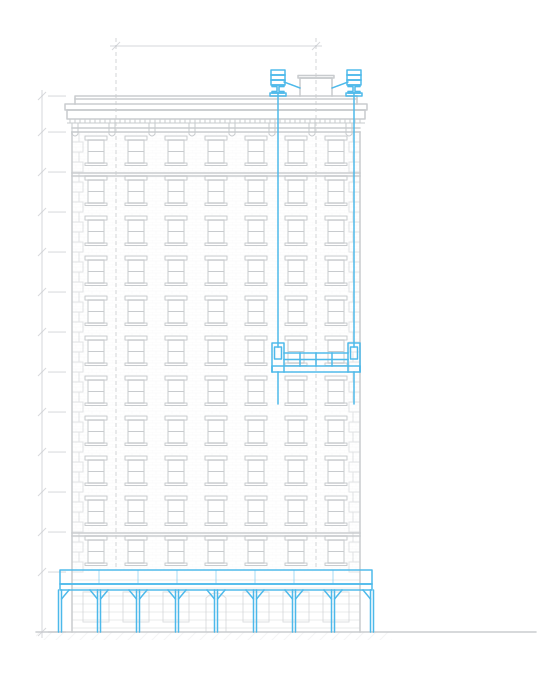
As a Local Law 11 contractor, Banu Construction carries out those repairs. We work through the report item by item with your QEWI: brick and repointing, lintels and shelf angles, parapets, terra cotta, cornices, balconies and sealants. We build each repair to your engineer's details, schedule it against your filing deadline and document it for the amended filing. We rig the access ourselves, with suspended scaffold hung under our own Special Rigger license.
SWARMP conditions have to be repaired within the cycle. Unsafe ones run on a much shorter clock: protection goes up first, then a repair plan that fits inside the 90-day correction window. We handle both, plus the routine maintenance a Safe façade still needs.
Every FISP condition has a date attached. Send us the report and we'll lay out how to meet each one.
Local Law 11 repairs we handle
Whatever your FISP report lists, one contractor does the repairs, on one schedule.
- Brick and masonry repairs Cracked and spalled brick replaced, joints repointed, bulging sections rebuilt and re-tied.
- Lintels and shelf angles Rusting steel over windows and at floor lines repaired or replaced, with new flashing.
- Spandrel beams and structural steel Steel behind the brick opened up, measured and repaired to your engineer's design.
- Parapets and coping Rebuilds, coping, flashing and railings, including Local Law 126 findings.
- Terra cotta Units pinned, patched, re-anchored or replaced to match.
- Cornices Made safe over the sidewalk first, then restored to the original profile.
- Decorative stone Carved sills, lintels and ornament patched, pinned or replaced.
- Balconies and railings Slab edges, reinforcing and railing anchors repaired stack by stack.
- Sealants and waterproofing Joints, coatings and through-wall flashing where water gets behind the façade.
- SWARMP repairs The list worked through on your QEWI's timeline, before anything is refiled as Unsafe.
- Unsafe conditions Public protection first, then repairs planned around the 90-day clock.
- Sidewalk shed removal The job sequenced from day one so the shed comes down as soon as DOB allows.
What your report says, and what it means for you
| Status | What it means | What happens next |
|---|---|---|
| Safe | No repair or maintenance needed to keep the façade safe for the next five years. | Keep up maintenance. Small items are easiest to fix before they grow. |
| SWARMP | Safe today, but conditions must be repaired within the cycle. | Plan the repairs. Unrepaired SWARMP must be filed as Unsafe at the next inspection, with a $2,000 penalty. SWARMP repairs → |
| Unsafe | Hazardous to people or property right now. | Public protection immediately. Correct within 90 days of filing, or request an extension. Unsafe repairs → |
Cycle 10 deadlines at a glance
| Sub-cycle | Block number ends in | Filing window |
|---|---|---|
| 10A | 4, 5, 6, 9 | Feb 21, 2025 to Feb 21, 2027 |
| 10B | 0, 7, 8 | Feb 21, 2026 to Feb 21, 2028 |
| 10C | 1, 2, 3 | Feb 21, 2027 to Feb 21, 2029 |
Why buildings bring us in
-
A schedule built backward from your deadline.
Your filing window, your 90-day Unsafe clock and your shed milestones sit on page one of our proposal.
-
A scope that matches the report.
Every condition gets its own line, numbered the way your QEWI numbered it, so you can follow each repair through to sign-off.
-
A clean handoff to your QEWI.
Photos of each repair, keyed to the report, so your QEWI can file the amended report without a second walk-through to chase what's missing.
-
A shed that comes down.
We sequence each elevation toward the day protection can come off.
-
Rigged under our own license.
Drops for your QEWI's close-up inspections and for the repairs are rigged under our own Special Rigger license, and we move them when the work calls for it.
How a Local Law 11 job runs with us
01 Before your filing
- A pre-inspection walk-through, so you know what's coming
- Suspended scaffold drops for your QEWI's close-up inspections (suspended scaffold)
- Repair of known conditions before the critical examination
- Repairs planned across sub-cycles A, B and C for multi-building portfolios
02 After your report
- SWARMP repairs, before they're refiled as Unsafe
- Unsafe condition remediation and public protection
- Local Law 126 parapet repairs and rebuilds
- Masonry, lintels, stone and terra cotta (façade restoration)
- Balcony, terrace and railing repairs
03 Sign-off
- A walk-through with your QEWI, and a punch list we finish
- Photo documentation keyed to the report for the amended filing
- The weekly work log the new shed rules call for
- Shed removal and sidewalk restoration
Who does what
Your QEWI inspects the façade (including hands-on, close-up inspections at intervals of no more than 60 feet along street-facing walls), classifies each condition, files the report with DOB, and files the amended report after the repairs.
We provide access when it's needed, complete the repairs, keep the shed and permits in order, and document each repair.
You sign the contract, keep the filing on schedule, and keep the public protected until DOB accepts the amended report.
Questions about Local Law 11 repairs
Which buildings does Local Law 11 apply to?
Every New York City building greater than six stories. FISP requires a close-up inspection of the exterior walls every five years, and the filing deadline for each building depends on the last digit of its tax block number.
Who files the FISP report, and who does the repairs?
Your QEWI, a New York State registered architect or engineer with at least seven years of relevant façade experience, inspects the building and files the report with DOB. We carry out every repair the report calls for and hand your QEWI the photos and documentation they need to file the amended report.
Our engineer filed the report. Can you do the repairs?
Yes, and that's where most of our Local Law 11 work starts. Send us the report. We walk the building with it, turn each condition into its own line in the scope, and build the schedule around your filing window and any shed deadlines.
What's the difference between Safe, SWARMP and Unsafe?
Safe means nothing needs repair to keep the façade safe for the next five years. SWARMP (Safe With a Repair and Maintenance Program) means it's safe today but has conditions that must be fixed within the cycle. Unsafe means something is hazardous now: the public has to be protected immediately, and the condition has to be corrected within 90 days of filing.
What happens if SWARMP items aren't fixed?
If SWARMP conditions from the last cycle are still there at the next inspection, your QEWI has to report them as Unsafe, and DOB charges a $2,000 penalty. That brings the shed, the 90-day clock and the new shed milestones with it. This guide shows how those penalties build up.
When is our Cycle 10 deadline?
It depends on the last digit of your tax block number. Blocks ending in 4, 5, 6 or 9 (sub-cycle 10A) must file by February 21, 2027. Blocks ending in 0, 7 or 8 (10B) by February 21, 2028. Blocks ending in 1, 2 or 3 (10C) file between February 21, 2027 and February 21, 2029. Our deadline finder checks yours by address.
Is FISP changing to a longer cycle?
Not yet. Local Law 49 of 2025, effective October 1, 2026, lets DOB set inspection intervals between 6 and 12 years by rule, but no rule has been adopted. Cycle 10 deadlines and the five-year cycle still apply. Any change would most likely apply from the next cycle, which starts in 2030.
Can the repairs be done before our QEWI inspects?
Yes, and it's often the best time to do them. Fix known problems before the critical examination and they can be reported as repaired instead of as SWARMP or Unsafe conditions. Talk to your QEWI about timing, and we'll coordinate with them.
Local Law 11 repairs across the city
- Manhattan: More than half of the city's FISP buildings.
- Brooklyn: About 3 in 10 initial reports were filed Unsafe in Cycle 9.
- Queens: Co-op complexes where the elevations to inspect and repair run into the dozens.
- The Bronx: About one in four FISP buildings ended Cycle 9 with no report on file.
- Staten Island: About 140 FISP buildings, mostly on the North Shore.
Source: NYC Open Data, DOB NOW: Safety – Facades Compliance Filings. See the data →
Let's talk about your building
Have a FISP report on your desk?
Send us your report or your block number. We'll tell you where you stand and lay out the work ahead.