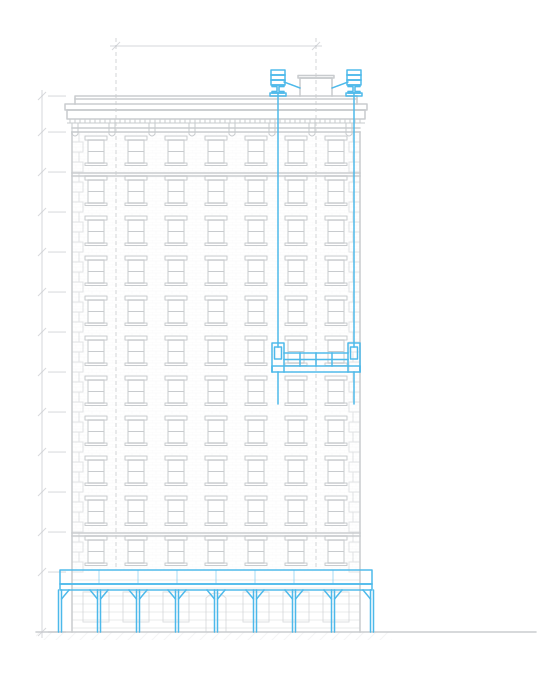
Say you manage a five-story walk-up, and someone has just told you the building needs a parapet inspection every year. You'd understood façade inspections to be for buildings over six stories. That's FISP. The parapet rule is a separate requirement, and it reaches a lot more buildings.
If your observation has already flagged something, our page on parapet repairs and rebuilds covers the fix. This article is about the rule itself.
What counts as a parapet?
DOB's rule defines a parapet as the part of any wall entirely above the roof line. On most New York buildings that's the low wall around the roof edge, capped with stone, terra cotta or metal coping. It takes more weather than any other masonry on the building, because rain and wind reach it from the front, the back and the top.
Does your building need a parapet observation?
Probably. Local Law 126 of 2021 created the requirement, and DOB's rule, 1 RCNY 103-15, applies it from January 1, 2024. It covers every building with a parapet fronting a public right-of-way, regardless of height. Only two kinds of building are exempt:
- detached one- or two-family homes
- buildings with a fence or other barrier that prevents access to the exterior wall
Height is where people get caught out. Nearly 13,000 tax lots in Manhattan, Brooklyn, Queens and the Bronx have buildings with exactly six floors, just under the FISP threshold (see our borough data). Every one of those with a street-facing parapet needs a yearly observation.
Who can do the observation?
The rule asks for "a person competent to inspect parapets" and gives examples: a bricklayer, building superintendent, handyman, mason or someone in a similar construction trade, an architect, an engineer, an inspector working for a New York State authorized insurance company, a New York State authorized building inspector, or any other individual capable of identifying hazards.
No license is required, and it doesn't have to be your QEWI. Pick someone who will get up close to the whole parapet and write down what they see, because next year's observer will be working from those notes.
What does the observation have to check?
The rule calls for a close-up inspection of the entire parapet, which can be done from a fire escape or the roof. The observer checks three things:
- Plumb. The parapet has to be plumb within one-eighth of its cross-sectional thickness. Any lean beyond that is a finding, and on a thin parapet it doesn't take much.
- Deterioration. Displacement, horizontal or diagonal cracks, missing or loose bricks or coping stones, deteriorated mortar joints, spalling, or rot.
- Anything attached to it. Appurtenances such as telecommunications equipment, railings, roof access rails, gooseneck ladders, handrail attachments for fire escapes and signs have to be installed and maintained in a stable condition.
What goes in the report?
The report has to include:
- the building's address and the owner's name
- the observer's name and affiliation
- the date of the observation
- a location plan
- construction details of the parapet
- the conditions found
- repairs made since the last report
- dated photos of the conditions at the time of the observation
It isn't filed with DOB. You keep each report for at least six years and hand it over if DOB asks, so keep them together in one place. The first thing next year's observer should do is read this year's report.
What happens if the observer finds something unsafe?
Three things, all on short deadlines:
- Notify DOB immediately. DOB's parapet page tells the observer to call 311 and email parapets@buildings.nyc.gov.
- Protect the public immediately. That means a sidewalk shed, removing the unsafe condition, fencing off the area, safety netting, or a combination.
- Correct it within 90 days.
Get the repair scope started in the first week. When a parapet needs a rebuild, 90 days goes quickly once permits and access are involved.
What usually gets flagged?
Most findings start at the top, because that's where the water gets in. On the parapets we're called out to, the list tends to look like this:
- coping stones that are loose, rocking or cracked
- open joints between coping units
- cracks through the parapet, often at the corners
- a lean in or out, sometimes from a roof membrane pulling on the inside face
- loose or missing brick and eroded mortar
- rusted railing posts and anchors that have cracked the masonry around them
- plants growing out of the joints
- water stains on the top-floor ceiling below
Freeze and thaw does the rest. Water gets into an open joint, freezes, expands, and pushes the masonry a little further apart each winter.
What drives the repair scope?
The crack in the report is where the scope starts. Where it ends depends on a few other things:
- How much of the parapet is affected. Resetting a few coping stones and rebuilding a full elevation are different jobs.
- Whether the cause gets fixed. Repoint without new flashing under the coping, and the same finding usually shows up again in next year's report.
- The roof edge. If the roof membrane is pulling or leaking at the parapet, the roofing work belongs in the same scope.
- Railings and anchors. Rusted anchors can mean new anchorage or a new railing.
- Access and protection. A parapet over a busy sidewalk may need a shed or netting while the work is under way.
- Materials and landmarks. Matching terra cotta coping or historic brick adds lead time, and on a landmarked building the LPC permit has to be in hand before work begins.
When proposals come in, check that each one fixes the cause of the finding as well as the finding itself. Our guide to comparing façade repair proposals covers what else to look for.
Sources
- 1 RCNY 103-15 (Periodic observation of building parapets): nyc.gov/assets/buildings/rules/1_RCNY_103-15.pdf
- NYC DOB, Parapets: nyc.gov/site/buildings/safety/parapets.page
- NYC Admin Code §28-301.1.1
- LPC Permit Guidebook
- NYC PLUTO (lots with exactly six floors), pulled October 2, 2026
This article is general information, not legal advice. Your engineer or expediter confirms how the rules apply to your building.