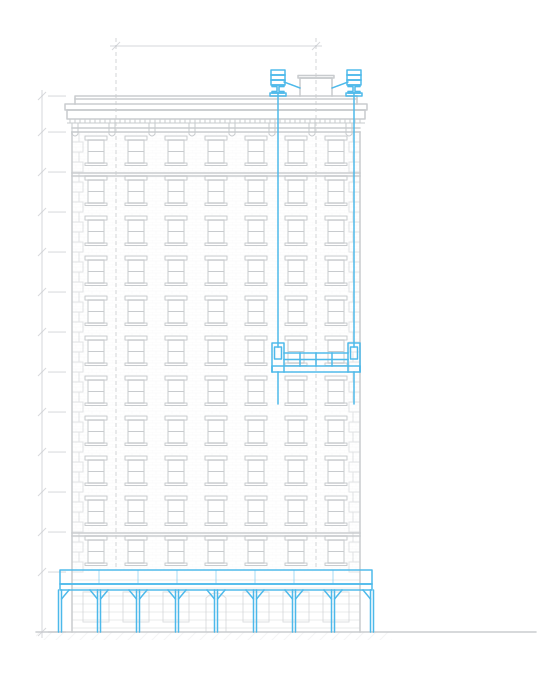
If terra cotta repairs are already on your desk, our terra cotta restoration page covers how we approach the work. The decision in front of your board is easier to state than to make: repair, replace in kind, or replace with something else.
Terra cotta is a bigger question in Manhattan than anywhere else in the city. Among buildings that reported their wall materials in FISP Cycle 9, 33% of Manhattan buildings listed terra cotta, against about 11% in the Bronx, 6% in Brooklyn and 1% in Queens. (See the data.)
Why does terra cotta fail?
Architectural terra cotta is fired clay, usually glazed, cast as hollow blocks open at the back with stiffening webs inside. The units were set in mortar and tied back to the building's steel frame with metal anchors. The glazed face sheds water well. The trouble starts behind it.
Once the glaze crazes or the joints open, water gets in and sits in the hollow cells. NPS Preservation Brief 7 is direct about what happens next: water that enters the system "can rust the anchoring system and substantially weaken or completely disintegrate those elements." Rusting anchors and frame steel expand and crack the units from the inside. Freeze-thaw cycles spall the glaze. A unit can look fine from the sidewalk and have almost nothing holding it to the building.
Old repairs often make it worse. Brief 7 warns that hard portland cement mortars, sealant used in place of mortar in the joints, and waterproof coatings all keep moisture from getting back out.
How do you find out what's wrong?
With hands on the wall. Brief 7 describes sounding each unit with a mallet: a sound unit rings, a deteriorated one sounds flat or hollow. Each unit also gets a close look for cracks, rust stains, open joints and displacement, and probes at representative locations show what the anchors and the steel behind them look like.
What you want at the end is a unit-by-unit map: repair, re-anchor or replace. That map sets the scope, the schedule and the order for new units, and it's what we work from on the scaffold.
What can be repaired?
- Pinning cracks. Stainless steel pins set across a crack hold the pieces together where the rest of the unit is sound.
- Patching small losses. Repair mortar made to be compatible with terra cotta: softer than the unit, able to breathe, and color-matched to the glaze.
- Re-anchoring. Taking a unit out, replacing the rusted anchor with stainless steel and resetting it, or installing new anchors through the face where removal would do more harm.
- Repointing. Mortar softer than the units, so the joints take the movement and the terra cotta doesn't crack.
A word on the source. Brief 7 was written in 1979. It discouraged patching and called removing and reanchoring units "an extremely difficult if not impossible task." Repair materials and methods have come a long way since then. Its central warning still stands: a repair that's harder or less breathable than the unit around it traps water and fails, and it takes original material down with it.
When does terra cotta have to be replaced?
Brief 7 says units that have "spalled severely thereby losing much of their material and structural integrity" should be replaced. On the wall, replacement is the right call when:
- the unit has lost much of its body as well as its glaze
- cracks run through the webs, so pins have nothing sound to grip
- the anchors are gone and the unit can't be removed and reset in one piece
- earlier patching has left little original material
- the unit had to come down in an emergency and couldn't be saved
New terra cotta, GFRC or cast stone: how do they compare?
New terra cotta is the same material, so it matches the glaze, the weight and the way the original moves with heat and moisture. It's made to order from shop drawings and molds, then fired and glaze-matched. Brief 7 notes that delivery time "is often quite lengthy" and that owners should plan far in advance.
GFRC (glass fiber reinforced concrete) is thin and light, can be molded directly from historic features, and holds crisp detail. That makes it useful where weight or attachment is the problem, projecting cornices for example. NPS Preservation Brief 16 lists the drawbacks: it's for non-loadbearing use only, it generally needs a separate anchorage system, color additives may fade in sunlight, and it may absorb water at a different rate from the historic material next to it. It isn't fired, so there's no true glaze; the finish comes from the mix or a coating.
Cast stone and precast concrete are heavier and solid. Brief 16 names cast stone as a substitute for "terra cotta in imitation of stone," with expansion and contraction similar to stone and good vapor permeability, though it can absorb more water than natural stone and its color may fade. A lot of New York's terra cotta was glazed to look like stone, and that's where cast stone fits best.
To choose, start with what LPC will allow. Then weigh where the unit sits, how much it weighs, how many you need and how long you can wait, and picture how each option will look next to the original in twenty years. New terra cotta ages the way the original does. A substitute ages its own way, which is why Brief 16 recommends weathering samples over several seasons to check color stability.
How long does replacement take?
The sequence runs survey, shop drawings, samples, approvals, molds, manufacture, delivery, installation. Plan in months. If a unit is Unsafe, the clock is shorter: repairs are due within 90 days of the filing, and an extension of up to 90 days is available with documentation and a $305 fee. Make the building safe first, order replacement units early, and keep the rest of the work moving. More on Unsafe façade repairs.
Who decides on a landmarked building?
LPC. Exterior work needs an LPC permit before it starts. Under the staff-level criteria in LPC's Permit Guidebook, terra cotta at or below the sixth story of the primary façade is replaced in kind, substitutes are allowed for coping and in limited other cases, and individual landmarks are held to a stricter standard. Proposals outside those criteria can go to the Commission at a public hearing. Façade work on a landmarked building covers the permits and the timing.
Sources
- NPS Preservation Brief 7, The Preservation of Historic Glazed Architectural Terra-Cotta (1979): nps.gov/orgs/1739/upload/preservation-brief-07-terra-cotta.pdf
- NPS Preservation Brief 16, The Use of Substitute Materials on Historic Building Exteriors: nps.gov/orgs/1739/upload/preservation-brief-16-substitute-materials.pdf
- NYC LPC Permit Guidebook (replacing brick and terra cotta): nyc.gov/assets/lpc/downloads/pdf/LPC-Permit-Guidebook.pdf
- NYC Open Data, DOB NOW: Safety, Facades Compliance Filings (Cycle 9 wall materials): data.cityofnewyork.us/resource/xubg-57si.json
- NYC Admin Code §28-302.5 and 1 RCNY 103-04 (Unsafe conditions, 90-day correction, extensions)
This article is general information, not legal advice. Your QEWI, architect and LPC staff confirm what applies to your building.