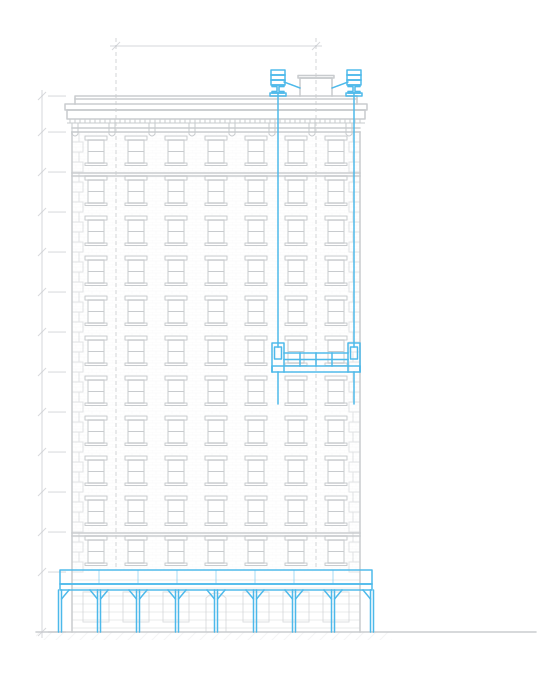
Your engineer called. The report went in Unsafe, the board president wants to know what that means by Friday, and residents are already asking about the shed.
The steps below run in a set order, and each one has an owner. If you need a contractor on it today, start with our page on Unsafe façade repairs.
What does the 90-day timeline look like?
| When | What happens | Who |
|---|---|---|
| Day 0 | Report filed. DOB and the owner notified. The 90-day clock starts. | Your QEWI |
| Days 0 to 1 | Shed, fence or netting installed. Loose material made safe where possible. | Owner and contractor |
| Days 1 to 3 | Board, residents and tenants told. Every deadline written down. | Owner or managing agent |
| Week 1 | Site walk with the report. Scope, schedule and design professional lined up. | Contractor, QEWI or engineer |
| Weeks 1 to 4 | Construction documents and DOB permit application. LPC application if landmarked. | Engineer or architect, expediter |
| Once permits issue | Repairs, with a weekly log and photo reports. | Contractor |
| Well before day 90 | Extension request, if the work can't finish in time. | Owner, with QEWI and contractor |
| Within 2 weeks of completion | QEWI re-inspects and files the amended report. | Your QEWI |
| After DOB accepts | Protection removed, sidewalk restored. | Contractor |
When does the 90-day clock start?
On the day the report is filed. The rule gives you 90 days from the filing to correct the condition. Get the exact filing date from your QEWI, circle day 90, and plan everything backward from it.
What has to happen in the first 24 hours?
Protect the public. Your QEWI advises on the measures, usually a sidewalk shed, sometimes fencing or netting, and they go up immediately. Any loose material that can be safely removed or secured gets made safe at the same time.
Shed permits are issued to registered general contractors, and rigging outside the building must be done by or under a licensed rigger. If you don't have a contractor yet, line one up today.
Then note the date of the first shed permit. If it was issued on or after January 12, 2026, Local Law 51 of 2025 starts a second clock: complete construction documents filed within 5 months, a complete permit application filed and diligently pursued within 8 months, and repairs completed within 2 years.
Who needs to be told?
- The board or owner: The report, the deadline and a first plan.
- Residents: The shed, any limits on windows, terraces or balconies, and when work starts.
- Commercial tenants: Storefront access, and signage under the shed.
- Your insurance broker: The condition and the planned work.
- Neighbors: If the repair needs their roof or property.
What happens in week one?
Walk every Unsafe condition with your contractor, report in hand, and look hard at what's around each one. Unsafe items rarely sit alone. By the end of the week you want a written scope keyed to the report's numbering, a schedule built back from day 90, and an architect or engineer already working on the construction documents.
Which permits do the repairs need?
Unsafe repairs generally need a DOB permit before permanent work begins. Your design professional prepares the construction documents, and the application gets filed, often by an expediter.
On an individual landmark or in a historic district, you also need an LPC permit before work begins: usually a Certificate of No Effect for FISP repairs that don't affect protected features, a Permit for Minor Work for masonry repair that doesn't need a DOB permit, or a Certificate of Appropriateness, with a public hearing, for significant changes. File with LPC and DOB in the same week. Waiting on one before starting the other is the easiest way to lose a month. See landmark restoration.
How do you keep the repairs moving?
Ask your contractor for regular photo reports and a work log. The 2026 shed rule requires a log updated at least weekly, and each 90-day shed permit renewal needs a progress report from a design professional. All of it should arrive without you having to chase it.
If opening the wall shows more damage than the report did, stop. Photograph it, show your QEWI, and get the added scope agreed in writing before anyone carries on.
What if 90 days isn't enough?
Apply for an extension, and don't wait until day 89. DOB can grant an extension of up to 90 days for a $305 fee. The rule asks for:
- notice that the premises are secured with a shed, fence or other protection
- a copy of the contract showing the scope of work to correct the Unsafe conditions
- your QEWI's estimate of how long the repairs will take
- a statement of the permits the work requires
- a notarized affidavit from the owner that the work will be finished within your QEWI's estimate
Financial considerations aren't accepted as a reason for an extension. Further extensions are possible only for unforeseen delays such as weather or strikes, unforeseen events such as a fire or collapse, or a hazard that needs more than 90 days to fix.
When we're the contractor on an Unsafe job, we pull the contract, schedule and progress records for this request together early, so the owner can file well ahead of day 89.
How does the shed come down?
When the repairs are complete, your QEWI re-inspects and files an amended report within two weeks. The amended filing fee is $425. Protection stays up until DOB accepts the amended report, or approves your QEWI's signed and sealed request to remove it because the conditions are corrected. That second route is what lets a building repaired elevation by elevation take its shed down in sections. More in how to get your sidewalk shed down.
What penalties apply if you miss the deadlines?
- Failure to correct Unsafe: Under 1 RCNY 103-04, $1,000 a month. From the second year, add a charge per linear foot of shed per month: $10 in year two, $20 in year three, $30 in year four and $40 in year five.
- Local Law 51 milestones (sheds first permitted on or after January 12, 2026): a penalty of $5,000 to $20,000 for each missed milestone (construction documents, permit application, completion).
- Local Law 48 idle-shed penalties: From the second renewal, per linear foot per month for a shed with no active work: $10 if it's under 3 years old, $100 at 3 to 4 years, $200 after 4 years (that tier capped at $6,000 a month). DOB expects to begin imposing them in early 2027.
Sources
- 1 RCNY 103-04 (Unsafe conditions, extensions, amended reports, penalties): nyc.gov/assets/buildings/rules/1_RCNY_103-04.pdf
- NYC Admin Code §28-302.5 (Unsafe conditions)
- NYC DOB, Façade Fees & Penalties: nyc.gov/site/buildings/safety/facade-fees-penalties.page
- Local Law 48 of 2025: nyc.gov/assets/buildings/local_laws/ll48of2025.pdf
- Local Law 51 of 2025: nyc.gov/assets/buildings/local_laws/ll51of2025.pdf
- 1 RCNY 102-07: nyc.gov/assets/buildings/rules/1_RCNY_102-07_prom_details_date.pdf
- LPC Permit Guidebook
- NYC Admin Code §28-404 and §28-418; Building Code §3314.4.5.4 (licensing)
This article is general information, not legal advice. Your QEWI and expediter confirm how the rules apply to your building.