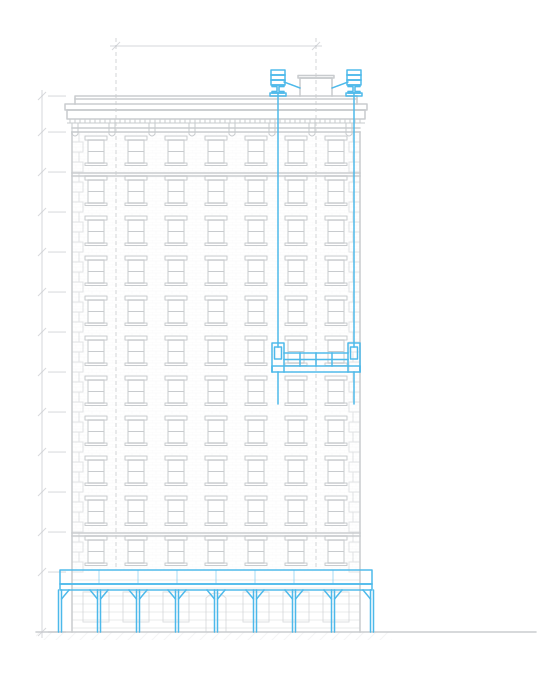
If your board runs a post-war white brick building, you've probably seen the pattern: brick faces popping off near the corners, cracks along the floor lines, and the same repairs coming back every cycle. For the basics of brick repair, start with our page on masonry restoration. Glazed brick has problems of its own, and they start with the glaze.
Why did so many buildings use white glazed brick?
Manhattan House, at 200 East 66th Street, was completed in 1951. Its designation report cites an early description of "a light self-washing glazed brick" that would reflect sunlight. The Landmarks Preservation Commission, which designated the building a landmark in 2007, says it "helped make white brick a fashionable material," especially on the Upper East Side, and that for the next decade and a half many Manhattan apartment buildings used similar materials.
The appeal was practical. A glazed face stayed bright without paint and was supposed to shed city grime. The problem is what the glaze does to water.
Why does glazed brick spall?
Ordinary brick gets wet and dries out through its face. A glazed face is far less permeable, so the wall behind it dries slowly. RAND Engineering, which has written about these buildings, describes the glaze as trapping moisture behind the face, where it freezes and makes the brick spall, pop and crack.
Water still finds its way in:
- cracked or open mortar joints
- failed sealant at windows and expansion joints
- parapets and copings without working flashing
- cracks at shelf angles and lintels where the steel has started to rust
Once it's in, the water can't leave through the glaze the way it would through ordinary brick. In winter it freezes just behind the face, expands and pushes the glaze off, and every freeze-thaw cycle does it again. The wall can look fine from across the street and be failing unit by unit up close.
Steel makes it worse. Many of these buildings carry their brick on steel shelf angles at each floor and steel lintels over the windows. Wet steel rusts, rust takes up more room than the steel did, and the brick above it cracks. Brick walls also need room to move with temperature, and where there aren't enough soft joints the brick cracks at corners and floor lines on its own. (More on rusting lintels and cracked brick.)
What does the damage look like?
The same conditions turn up in FISP reports on these buildings again and again:
- Spalled faces: The glaze and a thin layer of brick gone, leaving a rough, darker spot
- Crazed or cracked glaze that hasn't let go yet
- Horizontal cracks at floor lines, often with rust staining, where shelf angles are corroding
- Vertical cracks at corners, where the wall has nowhere to move
- Bulging or displaced brick at parapets and corners
- Open joints and failed sealant around windows
- Patches from earlier cycles in a slightly different white
What are your repair options?
Selective replacement and repointing
Cut out the damaged units, install matching glazed brick, repoint failed joints and replace failed sealant. When damage is scattered, this is the right answer. By itself it treats the symptoms, and if water keeps getting in, the new brick will spall too.
Local rebuilds
Where damage is concentrated (corners, parapets, a floor line), the brick comes off, the steel behind it is cleaned and coated or replaced, flashing and soft joints go in, and the wall is rebuilt. On the glazed brick buildings we work on, this is usually the repair that holds up longest, because it deals with the cause.
Re-cladding
When damage is widespread and returns after every round of repairs, some boards remove the glazed brick on whole elevations and replace it with new brick, often unglazed, or another cladding system. RAND calls this "reskinning." It's the largest option: engineering design, DOB permits and a long stretch of scaffold and protection. The case for it is that a new wall, detailed to drain and dry, can end the cycle of patching. Our re-cladding page covers the systems.
How to choose
Ask your engineer to map the damage elevation by elevation, with probes at floor lines and corners. The pattern tells you whether you have scattered spalls or a systemic problem. The scope follows the same map: how many units, how much steel needs work, and how long access and protection have to stay up.
Can new glazed brick match the old?
Usually close, rarely perfect. "White" glazed brick from that era runs from bright white to gray-white, and the existing brick has had decades of weather. What helps:
- Clean a test area first, so you're matching the brick under the grime.
- Put sample panels on the building and look at them from the street before ordering.
- Use salvaged brick from the rebuilt areas on the most visible elevations, and new brick where it's least noticeable.
- Check the size, so new units line up with the old coursing.
- Order early. Matched glaze colors are made to order.
What if your building is a landmark?
Manhattan House is an individual landmark. If your building is one, or sits in a historic district, exterior work needs an LPC permit before it starts. Most FISP repairs that don't affect protected features get a Certificate of No Effect. Masonry repair that doesn't need a DOB permit gets a Permit for Minor Work. LPC's staff-level criteria say brick must be replaced in kind, with no substitute materials. Switching to a different brick, or re-cladding, is the kind of significant change that generally needs a Certificate of Appropriateness, and that means a public hearing. See façade work on a landmarked building for how to plan around it.
Sources
- NYC Landmarks Preservation Commission, Manhattan House designation report (LP-2246, October 30, 2007): s-media.nyc.gov/agencies/lpc/lp/2246.pdf
- RAND Engineering & Architecture, "The Problem With White Brick Buildings" (2011): randpc.com/news/the-problem-with-white-brick-buildings/
- NYC LPC Permit Guidebook (brick replacement criteria; permit types): nyc.gov/assets/lpc/downloads/pdf/LPC-Permit-Guidebook.pdf
- 1 RCNY 103-04 (FISP condition classifications): nyc.gov/assets/buildings/rules/1_RCNY_103-04.pdf
This article is general information, not legal advice. Your QEWI and architect confirm how the rules apply to your building.